How Exact Name Match filters Google Maps results by business name
Exact Name Match is an optional Google Maps Leads Scraper filter that keeps only results whose business name contains your search query — ideal for scraping a single brand or chain like Peugeot or Starbucks.
Sometimes you're not after every business in an area — you want one specific brand or chain. Exact Name Match is an optional filter in the Google Maps Leads Scraper that keeps only the results whose business name matches what you searched for, and drops everything else.
It's built for one job: chasing a specific brand (like Peugeot, McDonald's, or Starbucks) without pulling in every unrelated business that happens to appear in the search area.
Exact Name Match is off by default. Turn it on only when you're targeting a single brand — it's the wrong tool for broad categories like "all coffee shops."
Where to find it
Exact Name Match is a simple on/off toggle (a checkbox) in your batch's settings, under the advanced / detail options.
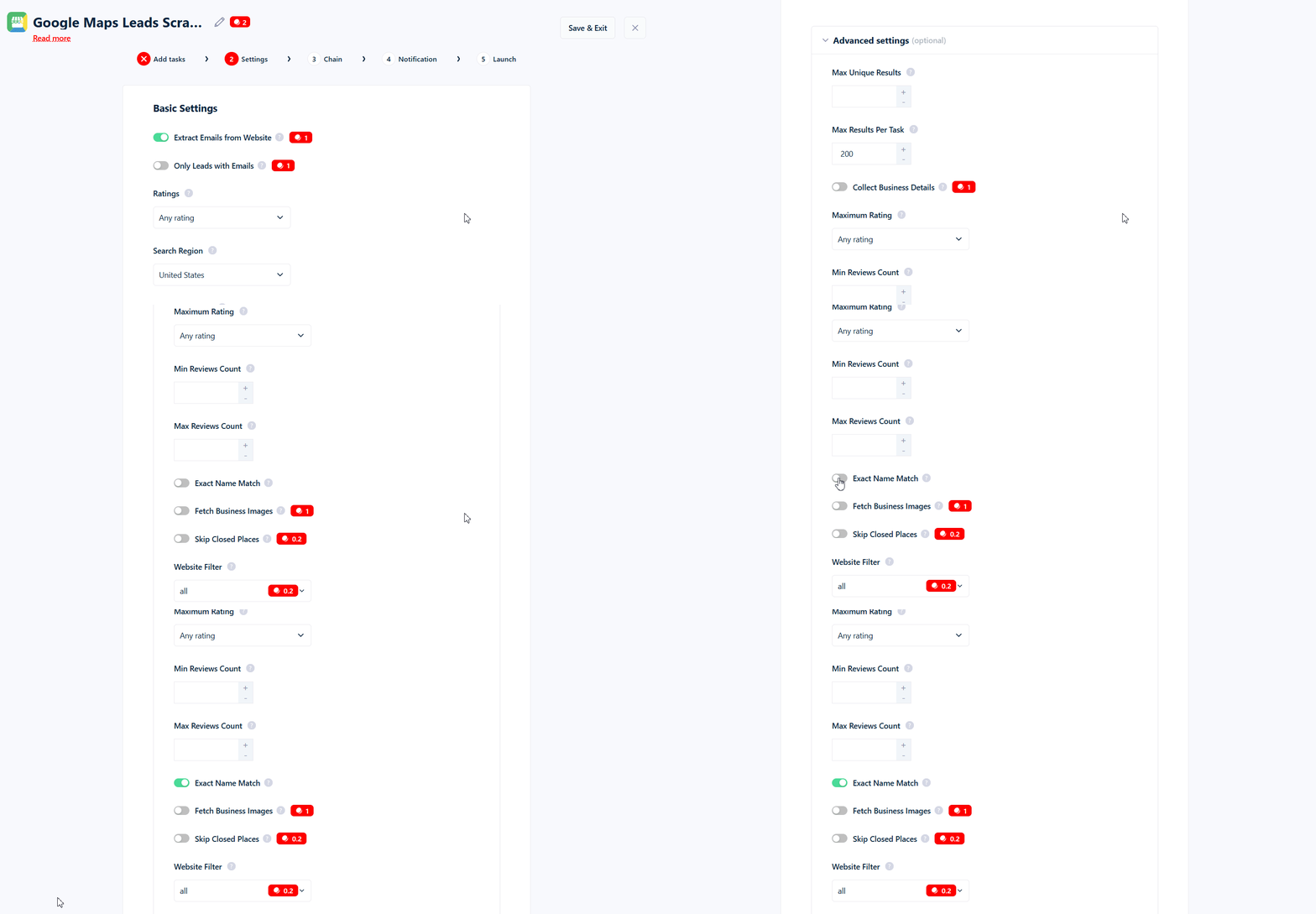
There is no separate box to type names into. The filter automatically compares each business name against the text you already entered in the Category / Search Query field. Whatever you typed to run the search is also what the names are matched against.
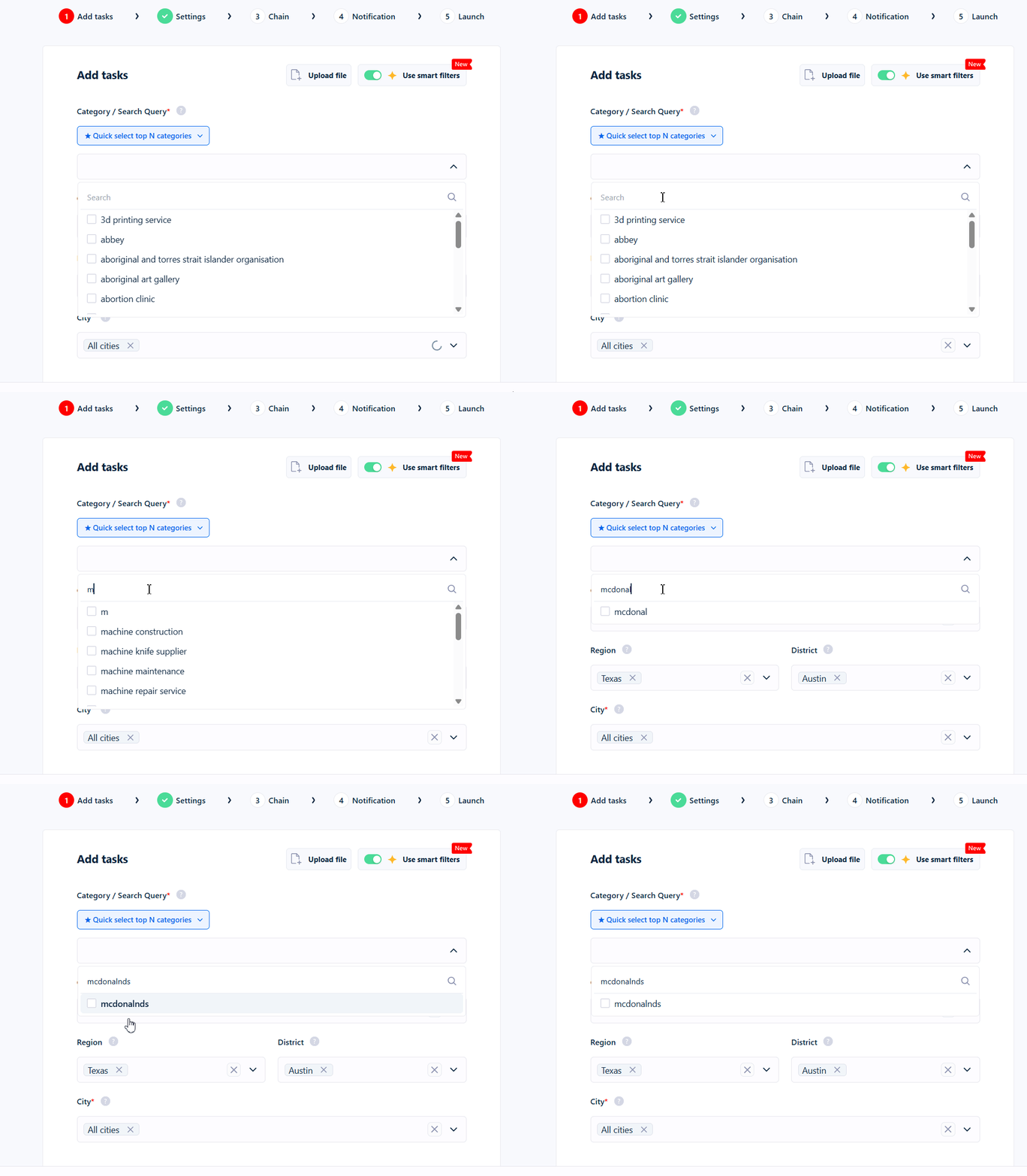
Example: If your Category / Search Query is Peugeot, turning on Exact Name Match keeps only results whose name contains "Peugeot" and removes everything else.
If your tasks are Google Maps search URLs instead of plain keywords, the keyword inside the URL is used as the query. When you're using this filter, stick to keyword tasks or search URLs so there's always a query to match against.
How the matching works
This is the most important part to understand, because the name is a little misleading.
Exact Name Match keeps a result when your search query appears anywhere inside the business name. It does not require the name to be exactly equal, and the query does not have to be at the beginning of the name.
%%{init: {"flowchart": {"htmlLabels": true, "nodeSpacing": 55, "rankSpacing": 70}, "themeVariables": {"fontSize": "16px"}}}%%
flowchart TD
    N["<b>Business name</b><br/><i>e.g. Garage Citroën Lyon</i>"]
    Q["<b>Your search query</b><br/><i>e.g. citroen</i>"]
    C["<b>Tidy up both sides</b><br/><i>ignore case, accents,<br/>punctuation and spacing</i>"]
    D{"<b>Does the name contain<br/>your query anywhere?</b>"}
    K["<b>Kept</b>"]
    X["<b>Dropped</b>"]

    N --> C
    Q --> C
    C --> D
    D -->|"yes"| K
    D -->|"no"| X

    style N fill:#fef3c7,stroke:#d97706,stroke-width:3px,color:#000
    style Q fill:#fef3c7,stroke:#d97706,stroke-width:3px,color:#000
    style C fill:#eef2ff,stroke:#4f46e5,stroke-width:3px,color:#000
    style D fill:#eef2ff,stroke:#4f46e5,stroke-width:3px,color:#000
    style K fill:#ecfdf5,stroke:#059669,stroke-width:3px,color:#000
    style X fill:#fee4e4,stroke:#c00,stroke-width:3px,color:#000
Before comparing, both your search query and the business name are cleaned up so small differences don't get in the way. Matching is:
- Not case-sensitive —
peugeot,Peugeot, andPEUGEOTare all treated the same. - Accent-insensitive —
cafematchesCafé, andcitroenmatchesCitroën(and the other way around). - Punctuation- and spacing-insensitive — dots, hyphens, apostrophes,
&, and extra spaces are ignored. SoSt-Denis,St Denis, andStDenisare all treated as the same thing, andMcDonald'sis treated asMcDonalds.
Because spacing is ignored, there are no word boundaries — the comparison runs over one continuous string. A query can match the middle of a single word, not just the middle of a name.
What it does not do:
- It does not expand abbreviations.
Saint Deniswill not matchSt-Denis, andCompanywill not matchCo. - It does not understand related terms, categories, or translations — that's Category Match.
Contains, not starts with: worked examples
These examples assume the toggle is on.
Search query: peugeot
| Business name | Kept? | Why |
|---|---|---|
| Peugeot | ✅ Yes | The name contains "peugeot" |
| Peugeot Lyon Centre | ✅ Yes | Contains "peugeot" |
| Garage Peugeot Bron | ✅ Yes | Contains "peugeot" — position doesn't matter |
| Renault Lyon | ❌ No | Doesn't contain the query |
Search query: geot (partial word)
| Business name | Kept? | Why |
|---|---|---|
| Peugeot Lyon Centre | ✅ Yes | "geot" appears inside the name — that's enough |
Search query: citroen (accents and casing)
| Business name | Kept? | Why |
|---|---|---|
| Citroën | ✅ Yes | Accent is ignored, so it matches "citroen" |
| Citroën Garage Lyon | ✅ Yes | Contains "citroen" |
| Garage Citroën | ✅ Yes | Contains "citroen" |
Search query: mcdonalds (apostrophes and spacing)
| Business name | Kept? | Why |
|---|---|---|
| McDonald's | ✅ Yes | Apostrophe and capitals are ignored |
| McDonald's To Go — Midtown | ✅ Yes | Punctuation and spacing are ignored |
| Burger King | ❌ No | Doesn't contain the query |
Abbreviations work one way only
| Search query | Business name | Kept? | Why |
|---|---|---|---|
co | Acme Company | ✅ Yes | "co" happens to appear inside "Company" |
company | Acme Co | ❌ No | The query is longer than what's in the name |
Short queries match more than you expect. Because the query only has to appear somewhere in the name, a two- or three-letter query will pull in unrelated businesses. Use the full brand name.
Names written in non-Latin scripts are dropped. Japanese, Chinese, Cyrillic, Greek, Arabic and similar business names can't be compared, so they're removed while the toggle is on. Letters that have no plain-Latin equivalent are also affected — Straße is read as Strae, so a query of strasse won't match it. If you're scraping a market where names aren't written in Latin characters, leave this filter off.
Using a single search term
Exact Name Match works with one search query at a time. It does not support:
- Multiple names — you can't enter a list like
peugeot, citroenand match either one. Your whole query is treated as a single phrase, so only a name that literally contains "Peugeot Citroen" together would match. Neither "Peugeot Lyon" nor "Citroen Lyon" is kept. - Excluding names — there's no way to say "remove any result whose name contains X." The filter can only keep matches, not block them. A minus sign doesn't help either:
-peugeotis read aspeugeot, so it keeps Peugeot results instead of removing them.
If you need several brands, run a separate crawl for each one.
What happens when it's off
When the toggle is off (the default), names are not filtered at all — you get every result the search returned, subject to any other filters you've set.
How it works with the Category Match filter
When Exact Name Match is on, the name decides. A business whose name contains your query is kept even when its Google category doesn't match it: Peugeot dealers are filed as "Car dealer", and Category Match no longer drops them. A business whose name doesn't contain your query is skipped, whatever its category.
When the filter runs
Exact Name Match is applied after results are collected, and it's the last filter checked. It trims down the results you get, rather than changing how the search itself is performed.
Results dropped by the filter are removed before email and phone enrichment and before any credits are charged — so filtered-out businesses cost you nothing. You'll see a line in your run log for each one:
⚠️ Skipped 'Renault Lyon' — Name does not match queryTips and common mistakes
Use it for brands and chains, not generic categories. It shines for "only Starbucks" but is the wrong tool for "all coffee shops."
- Use the full brand name. Partial queries match inside other words and let unrelated businesses through.
- Don't expect abbreviations to be understood. "Saint" vs "St", "and" vs "&", and "Company" vs "Co" are all treated as different.
- One brand per run. Comma-separated lists won't work — split them into separate crawls.
- It matches your search query, not a custom list. You can't match a name that's different from what you searched for.
A note on the name
Although it's called Exact Name Match, it isn't a strict, character-for-character match: it ignores case, accents, and punctuation, and it accepts any name that contains your query anywhere. Think of it as "name contains my search term" rather than "name is identical to my search term."